
On a brisk Friday morning in mid-October 2025, Washington was jolted by yet another headline that seemed to blend reality TV with national politics. President Donald Trump announced that he had commuted the federal prison sentence of former congressman George Santos, ordering his immediate release from custody.
For many Americans, the name “George Santos” had already become synonymous with scandal. His dizzying rise and spectacular fall were among the most bizarre chapters in recent U.S. political history — a saga of fabrications, fraud, and finally, redemption through presidential clemency.
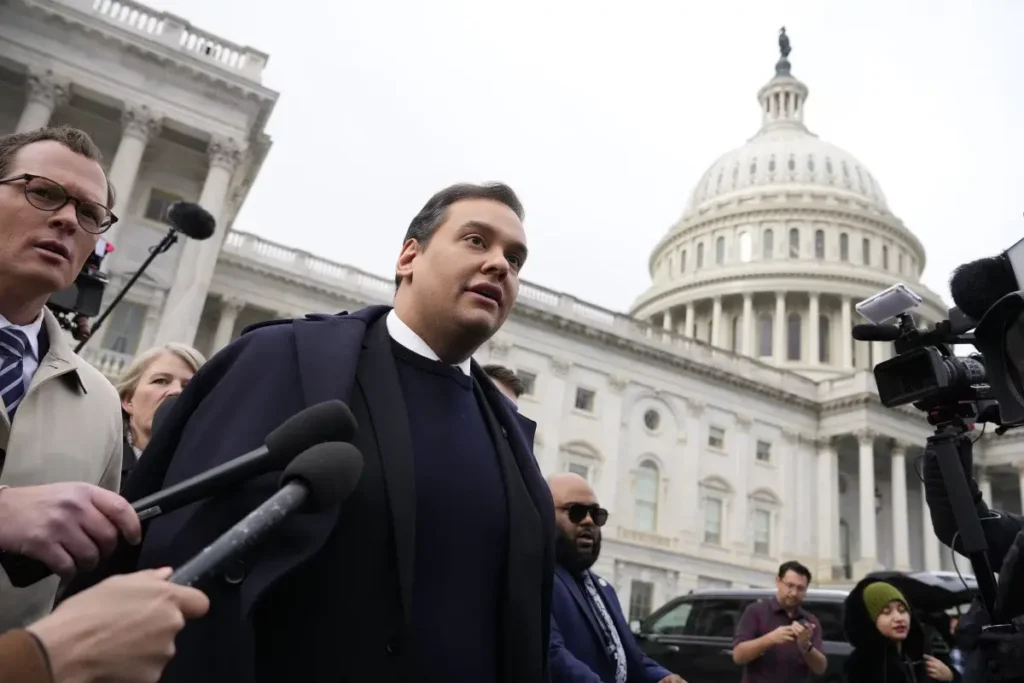
But Trump’s decision was more than just an act of mercy. It reignited long-running questions about how power, loyalty, and justice intersect in America’s political system.
The Rise and Fall of George Santos
George Santos first came to national attention in 2022 when he won a congressional seat representing parts of Queens and Long Island. He was young, energetic, and seemed to embody the diverse future of the Republican Party — openly gay, ambitious, and confident in front of the cameras.
That image collapsed almost overnight. After his election, journalists uncovered a web of lies in his biography: fake degrees, made-up jobs, fabricated family histories, and false claims of Jewish heritage. What began as political embarrassment quickly turned into a criminal case.
By mid-2023, federal prosecutors in New York had charged Santos with multiple counts of wire fraud, money laundering, and identity theft. Investigators alleged that he used donor money to pay personal expenses and even stole identities — including those of family members — to commit financial fraud.
Despite pleading not guilty at first, Santos eventually accepted a plea deal in 2024, admitting to several charges, including wire fraud and aggravated identity theft. In April 2025, a federal judge sentenced him to 87 months in prison — more than seven years behind bars.
When he reported to a federal correctional facility in New Jersey that summer, few thought he’d be free anytime soon. But politics has a way of rewriting fate.
Trump’s Sudden Move
On October 17, 2025, President Trump posted on his Truth Social platform:
“George Santos was somewhat of a ‘rogue,’ but there are many rogues throughout our Country who aren’t forced to serve seven years in prison. Therefore, I just signed a Commutation, releasing George Santos from prison IMMEDIATELY. Good luck, George — have a great life!”
With that message, Trump effectively erased the remainder of Santos’ prison time, though not his conviction. Within hours, the former congressman walked out of the Federal Correctional Institution in Fairton, New Jersey — free, stunned, and smiling.
The commutation did not amount to a full pardon. Santos remains a convicted felon. But the move spared him from serving years of incarceration, cutting short what was supposed to be one of the longer white-collar sentences for a former federal lawmaker in recent memory.
For Trump, it was another bold display of executive power — and a reminder that clemency, like politics itself, is often personal.
The Presidential Power of Mercy
Under the U.S. Constitution, the president holds sweeping power to grant pardons and commutations for federal offenses. It’s a power that dates back to the nation’s founding — a symbol of mercy, forgiveness, and discretion. But when used in politically charged cases, it can also stir outrage.
Trump has never shied away from using this authority. During his first presidency, he pardoned allies such as Michael Flynn and Roger Stone, calling their prosecutions “witch hunts.” Since returning to office in 2025, he has used clemency even more aggressively — issuing hundreds of pardons and commutations, many of them to political allies, January 6 participants, and conservative activists.
The Santos commutation fits squarely into that pattern. To Trump and his supporters, it’s an act of compassion and fairness — a correction of what they see as an overly harsh punishment for a non-violent offender. To his critics, it’s blatant favoritism, rewarding loyalty and eroding accountability for public corruption.
Either way, it’s a powerful reminder that in Trump’s political universe, loyalty rarely goes unrewarded.
Supporters Cheer, Critics Fume
Reaction was swift and polarized — much like everything in the Trump era.
The Supporters’ View
Conservative figures such as Rep. Marjorie Taylor Greene and media personalities on right-leaning networks celebrated the move. They argued that Santos’ crimes, while serious, didn’t warrant more than seven years in federal prison.
Greene wrote on X (formerly Twitter):
“George Santos did wrong, but the punishment was political. President Trump did the right thing — mercy over politics!”
Others suggested that Santos was treated more harshly because he was a high-profile Republican. Trump himself claimed Santos had been “mistreated” in prison and unfairly targeted by what he calls “the Deep State Justice Department.”
For these supporters, Trump’s decision represented a stand against a justice system they believe has been weaponized against conservatives.
The Critics’ View
Legal experts and ethics watchdogs saw it very differently.
“George Santos was convicted of defrauding donors and lying to voters,” said Noah Bookbinder, head of Citizens for Responsibility and Ethics in Washington. “Commuting his sentence sends the message that political allies of the president are above the law.”
Democrats in Congress echoed that sentiment. Rep. Jamie Raskin called the commutation “an insult to every honest public servant and a dangerous misuse of presidential power.”
Even some Republicans expressed unease. A few moderate GOP lawmakers privately told reporters that the move “crossed a line,” arguing that Trump’s willingness to intervene for someone convicted of such blatant dishonesty could undermine efforts to restore trust in the party.
What the Commutation Does — and Doesn’t — Mean
It’s important to understand that a commutation is not the same as a pardon.
A pardon erases the conviction, restoring the person’s rights as if the crime never occurred. A commutation, on the other hand, simply shortens or ends a prison sentence. The conviction still stands, and all other penalties — like fines, restitution, and public shame — remain in place.
In Santos’ case, this means he remains a convicted felon. He cannot vote or hold federal office unless he is later pardoned or has his rights restored by a court. He will also still owe restitution to campaign donors and victims of his fraud schemes.
But freedom, in practical terms, changes everything. Santos can now speak publicly, write, and rebuild his image — something he’s already hinting at. According to sources close to him, he’s planning a memoir titled The Truth About the Lies, reportedly chronicling both his political downfall and his relationship with Trump.
Why This Matters Beyond Santos
The broader implications of this decision stretch far beyond one disgraced congressman.
A Question of Equality Before the Law
When a sitting president commutes the sentence of a political ally convicted of abusing public office, it inevitably raises questions about fairness. Would an ordinary person — someone without access, fame, or loyalty to the president — receive the same mercy?
Legal scholars note that federal commutations are typically reserved for cases where the sentence was unusually harsh or the person has shown rehabilitation after serving significant time. Santos had served just three months. That fact alone has sparked debate over whether the decision was about justice or politics.
The Precedent It Sets
By intervening so early in Santos’ prison term, Trump may have set a new standard — one that future presidents could cite when granting similar favors.
“This commutation isn’t just about George Santos,” said former federal prosecutor Renato Mariotti. “It’s about the message it sends: If you’re loyal to the president, the rules might not apply to you.”
The Politics of Clemency
Trump’s use of clemency has always been deeply political. He often frames these decisions as acts of resistance against what he calls a corrupt establishment. To his base, that message resonates. To his opponents, it’s corrosive.
The Santos case underscores this duality: mercy on one hand, impunity on the other.
The Human Side of the Story
For all the legal and political noise, there’s also a deeply human story here — of ambition, deception, and the craving for redemption.
George Santos’ rise from obscurity to Congress was built on illusion. His lies were audacious, almost cinematic. Yet behind them, according to former aides, was a man desperate to belong — to matter.
His fall was swift and brutal. Expelled from Congress, branded a fraudster, and imprisoned, Santos became a national punchline. Now, with Trump’s intervention, he has a second chance — not at power, but at freedom.
When reporters caught up with him outside the prison gates, Santos offered a brief comment:
“I’m grateful to President Trump. I’ve made mistakes, but I believe in second chances. God bless America.”
He declined further questions.
Whether his newfound freedom will bring humility or more headlines remains to be seen. History suggests the latter.
A Pattern of Loyalty and Payback
Observers note that Trump’s act fits a familiar pattern — rewarding loyalty and defiance, often at odds with traditional notions of justice.
During his previous presidency, Trump granted clemency to political allies, law-enforcement officials convicted of misconduct, and wealthy donors. This latest wave of clemency in his second term appears even broader, encompassing everyone from January 6 rioters to conservative commentators charged with contempt.
In each case, Trump’s justification has been consistent: that the justice system is biased, that his allies are victims, and that he alone can make things right.
In that narrative, George Santos becomes not just a disgraced congressman, but a symbol — someone rescued from what Trump sees as a politicized system.
To critics, it’s an abuse of power disguised as compassion. To supporters, it’s strength cloaked in mercy. To historians, it’s another example of how Trump redefined — and weaponized — presidential norms.
The Fallout and What Comes Next
The legal consequences of the commutation are settled, but the political fallout is only beginning. Democrats have already announced plans to hold hearings on Trump’s use of executive clemency. Several watchdog groups are urging Congress to pass reforms requiring greater transparency in the pardon process.
For Santos, the road ahead is uncertain. Legally, he’s still a convicted felon. Politically, he’s toxic — though in today’s polarized landscape, that might not be a deal-breaker. Some conservative media outlets have already floated the idea of him joining Trump’s campaign operation or working as a political commentator.
Meanwhile, his former constituents in New York remain divided. Some see him as a symbol of deceit; others, surprisingly, as a victim of the system.
One Long Island voter told The Washington Post:
“He lied, yes. But who in Washington doesn’t? At least Trump gave him another shot.”
That kind of sentiment — cynical yet forgiving — captures much of the mood of modern American politics.
A Mirror of the Times
The story of George Santos and Donald Trump isn’t just about one man’s freedom. It’s about the moral temperature of American democracy.
Santos built his career on illusion; Trump built his on defiance. Both have thrived in a political culture that rewards spectacle over substance, loyalty over law. And both have shown how power, in the right hands, can rewrite the rules.
For some Americans, this commutation represents mercy and fairness. For others, it’s proof that accountability has become optional for the powerful. Either way, it’s a reminder that truth, justice, and politics are often entangled — and that in the age of Trump, they rarely mean the same thing to everyone.
Epilogue: The Unfinished Story
As night fell on the day of his release, George Santos posted a short message online:
“Freedom tastes sweeter the second time. Thank you, Mr. President.”
It was a fitting end to a story that began with a lie and ended with a signature. Whether that freedom leads to redemption or more controversy will depend, as it always has with Santos, on which version of himself the public chooses to believe.



Pingback: 3 takeaways from the second No Kings day of nationwide protests