A Nation on the Move
From coast to coast — from the bustling avenues of New York City to small towns across the Midwest and the deep South — a wave of protest swept the United States on Saturday 18 October 2025. Under the banner of No Kings protests, organizers say millions of Americans turned out in more than 2,600 rallies in all 50 states to express one simple, stark message: “We don’t have kings.”
The phrase “No Kings” captured the mood: a challenge to what many feel is a growing trend toward executive over-reach, unilateral action, and the erosion of democratic norms under Donald Trump’s administration. The protests carried both festive energy and anxious undertones: banners, costumes, families, retirees, veterans, all converging to walk and chant for democracy.
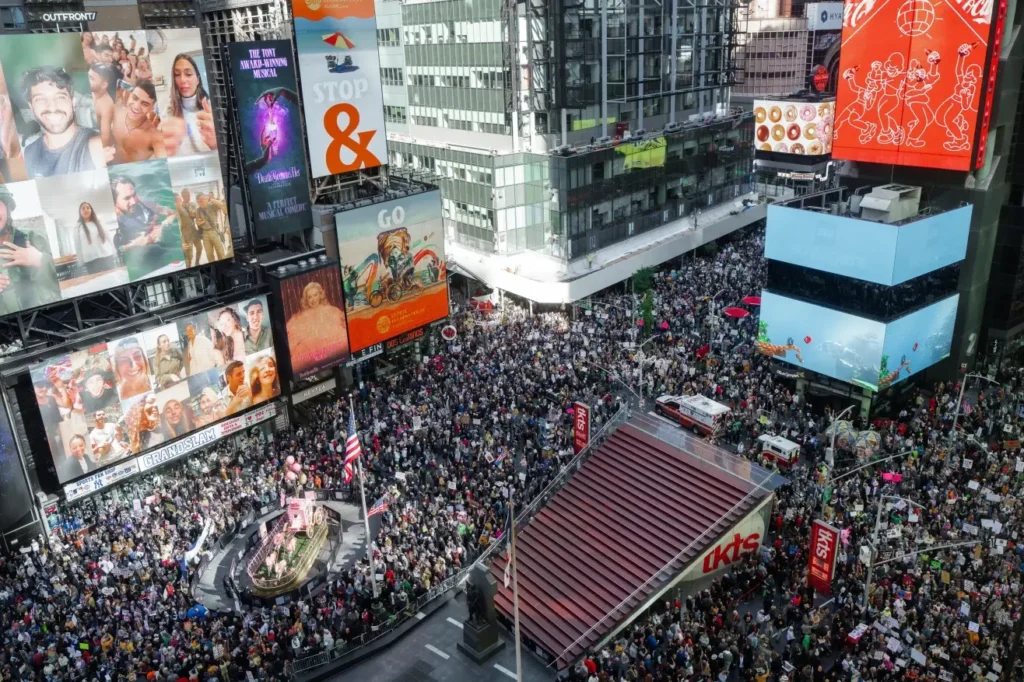
Among the scenes: In New York City, more than 100,000 people gathered in Manhattan alone. In Chicago, Washington, D.C., Los Angeles, San Francisco, and hundreds of smaller communities, people marched, chanted, waved flags, held inflatable art and protest signs. Despite the scale, reports note the atmosphere was largely peaceful and even celebratory in tone.
What Sparked It
A Resurgence of Resistance
This wave is not the first of the “No Kings” movement — earlier protests in June 2025 already drew thousands of events and an estimated 4-6 million participants across the country. The October protests built on that momentum, and organizers say they wanted to raise the stakes: these marches came at a moment when many Americans feel democratic safeguards are under threat.
The Ingredients
Several dynamics converged to fuel this surge:
The return of what some opponents call an aggressive style of governance: deployment of federal agents in cities, expanded immigration enforcement, and a strong executive posture.
The national government shutdown (at the time of the protests) and public frustration over stalled services, economic strain, and political stalemate.
A cultural moment: imagery of monarchy (“kings”) used deliberately, as a metaphor for concentration of power and for the protestors’ belief that the U.S. is meant to be a republic of equals, not a throne.
A broad coalition of civil-society groups: the American Civil Liberties Union (ACLU), Indivisible, teacher unions, immigrant advocacy groups, older voters, disaffected Republicans — all playing roles in mobilizing.
The Trigger(s)
One specific backdrop: the U.S. Army’s 250th Anniversary Parade, held in June, coincided with one of the earlier “No Kings” days, and was framed by some as emblematic of a militarised, top-down style of political spectacle. While not everyone at the protests cited that parade as the cause, it helped crystallize a narrative: power being put on display rather than delegated.
Voices from the Crowd
Among the thousands of marchers, the array of motives was wide. Here are some of the voices and themes that stand out:
Leah Greenberg, co-founder of Indivisible, said: “There is nothing more American than saying, ‘We don’t have kings’ and exercising our right to peacefully protest.”
A 70-year-old veteran in Portland wore a sweatshirt reading “No Kings since 1776” and drew on his service to underline why he felt the moment demanded his presence.
A former lifelong Republican in Houston, wearing a shirt labeled “Former Republican,” told reporters he felt his party was no longer the one he once supported: “The idea that one individual could have turned me away from the Republican Party is insane.”
Amid the carnival-style pageantry (inflatable frogs, costumes, balloon depictions of Trump in a nappy) there was also a profound sense of worry: one article noted that many protesters felt “their impact may be limited,” even as they gathered in huge numbers.
These voices reflect two intertwined sentiments: love of country and fear for its democratic future. The protests were as much about identity and values as they were about policy.
What They Were Protesting
Although the rallies were unified under the slogan “No Kings”, the actual grievances were multiple. Some of the key protest themes:
Executive over-reach and authoritarian tilt: Protesters pointed to what they see as a pattern of the president bypassing established norms, whether through using federal agents in cities, aggressive immigration enforcement, or mounting pressure on the judiciary and media.
Immigration and civil-liberties concerns: Many described the actions of agencies like U.S. Immigration and Customs Enforcement (ICE) and National Guard deployments in cities as harmful to basic rights. One protest in Houston included signs like “Fight ignorance, not migrants.”
Media, truth, and civic norms: For some participants, it was a fight over how information is managed, how dissent is treated, and whether institutions serve the public—or power.
Economic and social justice: While not always front-and-centre, these themes were present. One marcher said inflation and tariff policies under Trump factored into her decision to turn out.
Together, these grievances formed a wide umbrella under which people from different walks of life gathered.
The Scene on the Ground
Visually and atmospherically, the day was striking:
Marchers wore costumes, held inflatable figures (notably frogs), and used visually bold graphics.
In New York City’s Times Square, tens of thousands gathered and the atmosphere was described as both festive and resolute.
In smaller towns and suburbs, rallies were more modest in size but significant in symbolism: veterans, families, everyday citizens showing up.
Police in many cities reported zero protest-related arrests (for example NYC) despite the high numbers, suggesting the overall non-violent nature of the event.
The Response: Government, GOP, and Media
The President
Trump was not idle. On the eve of the rallies he said:
“They’re referring to me as a king. I’m not a king.”
Yet in his social-media activity, he posted an AI-generated video portraying himself as a crowned monarch, flying a jet, and bombing protestors with brown liquid. This ironic, surreal response drew both attention and criticism.
Republican Leadership
Leading Republicans responded with disdain or silence. Mike Johnson, Speaker of the House, labelled the protests a “hate America rally,” while others accused the movement of being extremist or tied to groups like Antifa.Most top-tier GOP officials stayed relatively quiet on the protests themselves.
Civil Society & Media
Major advocacy groups — the ACLU, Indivisible, teacher unions — praised the demonstrations as evidence of popular will and democratic engagement. Meanwhile, journalists and analysts observed that while the protests were “big, colourful and concert-like,” they also pointed to a growing sense of frustration among participants about how to turn protest energy into institutional change.
Scale & Significance
The simple metrics are staggering: an estimated millions of people — organizers claim perhaps seven million at the October event — in more than 2,600 separate locations. From a historical perspective, this may rank among the largest single-day demonstrations in U.S. history. For comparison, earlier mass protests include the 2017 Women’s March with millions, but “No Kings” stands out for its sheer spread (every state) and coordination across cities, towns and suburbs.
Beyond the numbers, the protests may mark a shift: not just spontaneous reaction but organised nationwide dissent with clear messaging. The “No Kings” branding gives a unifying metaphor — accessible, symbolic, rooted in American democratic tradition (“No kings” since 1776) yet pointed at contemporary anxieties.
Analysts note the scale is meaningful but caution that mass protests alone don’t guarantee policy outcomes. One clue: the so-called “3.5% rule” suggests that sustained participation of roughly 3.5% of a population is needed for movement success. With over 1 % of U.S. population possibly participating, the event signals momentum but not yet tectonic change.
What Could It Lead To?
Short-Term Effects
A renewed spotlight on the 2026 mid-term elections, local races, and internal Democratic strategy. The protest energy may push more voters to engage or raise expectations of party leadership to act.
Policy pressure: immigration enforcement, federal agent deployments, civil-liberties oversight may face increased scrutiny.
Messaging shift: the “no kings” metaphor may become a rallying cry in culture and politics — used by candidates, media, social-media campaigns.
Long-Term Possibilities
Movement building: if the “No Kings” coalition sustains momentum, it could evolve into a broader populist-democratic movement focused on checks and balances, executive power and civic rights.
Institutional change: Congress, courts or states might respond (or resist) demands for reforms in surveillance, policing, immigration and federal-state power.
Political realignment: seeing disenfranchised Republicans, independents and younger voters in the mix points to shifting alliances and perhaps changes in party coalitions.
Risks & Challenges
Protest fatigue: large single-day events can fade unless sustained by ongoing action.
Strategic ambiguity: with many grievances under the “no kings” umbrella, the movement may struggle to coalesce around specific policy demands. As one article noted, while the energy was high, many participants felt “powerless” about making concrete change. Backlash: opponents may interpret the movement as fringe, radical or un-American, especially given partisan polarization. The GOP framing of the event as “hate America rallies” underscores this risk.
What This Moment Says About U.S. Democracy
The “No Kings” protests are more than just big crowds. They reflect broader fault-lines in American politic and society.
Trust vs power: At the heart is a question of whether democratic institutions are protecting citizens or are being used by those in power for consolidation.
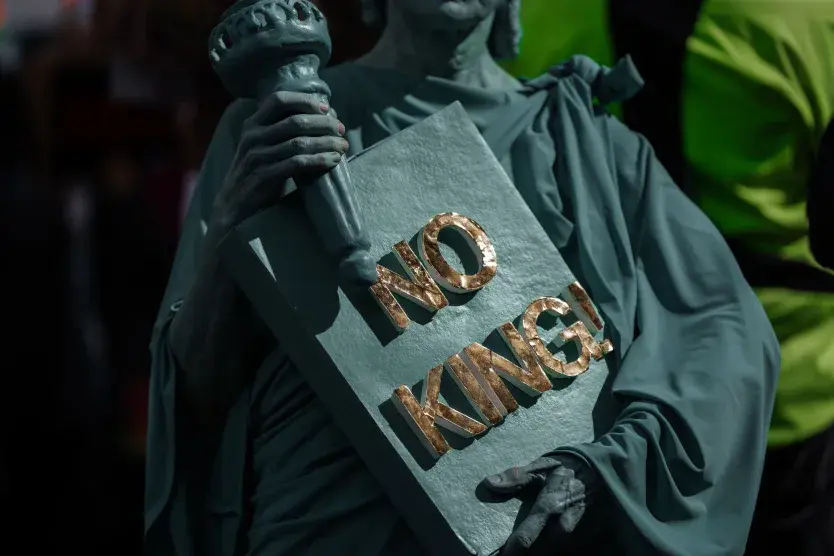
Symbolism matters: Protesters intentionally used monarchy imagery to reclaim the narrative: the U.S. isn’t meant to have kings. That symbolic act helps unify diverse groups.
Civic energy persists: Despite disillusionment and institutional gridlock, the willingness of millions to take to the streets says something important about civic commitment and resistance.
Fragmentation and unity: The coalition unified multiple causes — civil rights, immigrant rights, economic justice — but this breadth can also challenge coherence.
Global echoes: Such large-scale protests echo worldwide movements over democratic backsliding, executive concentration and political spectacle. The “No Kings” movement places the U.S. in that global context
Saturday’s “No Kings” rallies — colourful, massive, resolute — will likely be remembered as a watershed moment in the 2020s United States. Whether they spark lasting change or fade into a memory depends on what comes next: follow-through, strategy, institutional response and the capacity of ordinary citizens to sustain pressure.
Yet in the streets, the message was unmistakable: “We don’t bow. We don’t concede. We will take to the streets, we will voice our concerns, and we will remind this nation of its principles.”
Whether this marks a turning point or one major day among many remains to be seen. What is clear: a significant portion of America has raised its voice, refused to be silent, and insisted that in this country — there are no kings.