
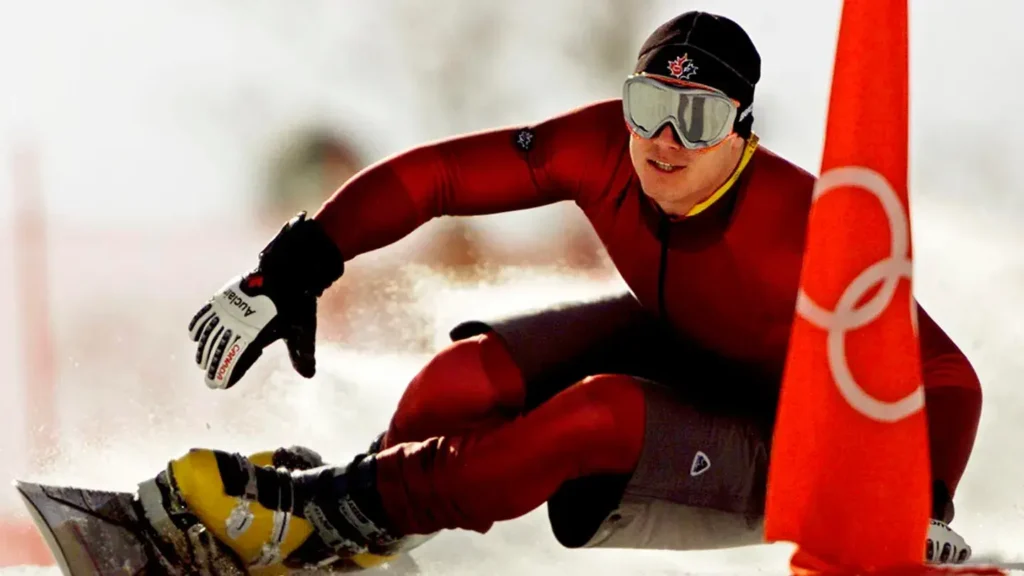
For most people, the Olympics represent the pinnacle of human achievement — a place where discipline, ambition, and national pride converge in moments of shared awe. However, there are moments when people who once stood proudly in the spotlight step so deeply into the shadows that their past becomes not a shining credential but rather an ironic footnote. Consequently, that seems to be the fate of Ryan James Wedding, a former Olympic snowboarder whose dramatic shift from athlete to alleged criminal mastermind now unfolds like a screenplay no one ever intended to write.
As U.S. authorities escalate their pursuit of Wedding — raising the bounty on his capture and sweeping up associates across North America — an entirely different storm is brewing in Washington, D.C. The Supreme Court of the United States is preparing to hear a pair of landmark cases over transgender participation in women’s sports, a cultural and legal fight carrying implications far beyond athletics.
The two stories are, on the surface, unrelated. Yet they speak in parallel about what sports mean in modern society — as a symbol, a battleground, a platform, and sometimes, an escape route. Together, they offer a glimpse into how athletics continues to intersect with law, identity, power, and the most contentious debates of our time.
A Fall From the Snow-Capped Heights
Once, the family of Ryan Wedding might have bragged about him in the way only families of Olympians can — with humble pride wrapped in unmistakable glow. Wedding competed for Canada in snowboarding, carving lines down icy slopes at elite levels. His early story fits a familiar mold: a driven athlete, a life of relentless training, and a future open to possibility.
The Ascent Toward Greatness
Pressure Building at the Peak
The Moment Everything Shifted
A Sudden Descent Into Crisis
The Impact After the Fall
Reflections on What Went Wrong
The Lessons Left Behind
That’s why the allegations against him land with such a thud of disbelief.
According to U.S. prosecutors, Wedding did not merely drift into the fringes of crime after his sports retirement; instead, they claim he went on to build a global narcotics network that was not only innovative but also violent, and therefore powerful enough to rival the infamous cartels whose reputations were forged in blood and billions. They accuse him of funneling multi-ton shipments of cocaine into North America, orchestrating operations across borders, and even ordering the killing of a federal witness who posed a threat to the empire he supposedly controlled.
To law enforcement, this is not merely a case of an ex-athlete gone wrong. It is the pursuit of a man they now describe as a “kingpin,” an unusually sophisticated operator whose athletic discipline may have mutated into something darker: an instinct for competition and dominance transposed onto the criminal world.
Wedding’s alleged network stretched from Colombia to Mexico to the United States and Canada, weaving together drug suppliers, transporters, financial facilitators, and hired enforcers. Some of his suspected associates — including legal and logistical support figures — have already been arrested. But the central figure remains at large, his precise location unknown, though investigators believe he is hiding under the protection of cartel-controlled territories.
The U.S. government’s response has grown equally dramatic. The reward for information leading to his capture now stands at $15 million, placing him among the most-sought fugitives in the Western Hemisphere. Furthermore, the escalation sends a clear and unmistakable signal: authorities now consider him not merely dangerous but also emblematic of a new class of criminal — one that is educated, internationally networked, and, therefore, able to move between countries with the ease of a seasoned competitor.
The Athlete’s Arc — A Mirror to Something Larger
Stories like Wedding’s fascinate not because criminality is rare, but because the fall from grace is. The Olympics are mythology in real time; athletes are cast as heroes in the global imagination. And heroism carries expectations — moral and personal — that are unfair at times but deeply ingrained.
When a figure from that world steps into villainy, it forces society to question its own narratives:
Do we expect too much of athletes
What happens when the rigid structure of elite sports disappears and the adrenaline stops?
How does the identity of “athlete” mutate when the cheering fades?
Experts often talk about the “post-career void,” a psychological that elite athletes face when retirement leaves them without routine, community, or purpose. For some, that void becomes destructive rather than introspective. For a very small group, it becomes criminal.
Wedding, if the allegations prove true, represents a version of post-athletic life that is extreme but nonetheless instructive. It highlights how the infrastructure around athlete transition — mental health resources, career planning — remains underdeveloped even in wealthy nations. Sports institutions celebrate competitive success but often lack systems for life after the final competition.
In that sense, Wedding’s case is not merely a manhunt. It is an indictment of how society both elevates and abandons its athletes.
A Nation’s Highest Court Steps Into the Arena
While border agents and police track Wedding across continents, U.S. legal institutions are grappling with a different kind of challenge: deciding who gets to compete, and under what terms, in the country’s school sports programs.
At the heart of the upcoming showdown are two cases — Little v. and West Virginia v. B.P.J. — that ask whether states can legally bar transgender girls and women from competing on female sports teams in public schools and colleges.
The debate is charged with emotion, ideology, and implications for Title IX, the federal statute that for decades has shaped sports equity in the United States. Now, Title IX sits at the center of a cultural tug-of-war over fairness, gender identity, biological differences, educational access, and what equality should look like in practice.
Supporters of the state-level bans argue that sex categories in sports exist for reasons tied to physiology and competitive integrity. They claim that allowing transgender girls to compete in women’s sports undermines fairness and safety. Opponents counter that such bans are discriminatory, that they rely on outdated stereotypes, and that they violate the rights and dignity of transgender youth seeking equal participation in school life.
Activist groups, advocacy organizations, women’s sports scholars, medical associations, conservative coalitions, and more than a hundred members of Congress have filed briefs. Each argues a version of what “justice” means in the athletic context. For some, justice is inclusion. For others, justice is competitive protection.
The Supreme Court’s decision will ripple through:
every educational district
all athletics departments
every state moving toward or already applying similar regulations
and ultimately, the national definition of what constitutes women’s sports.
This is not just a legal case. It is a referendum on identity, science, fairness, and how sports function as a microcosm of society.
The Collision of Two Narratives
You could not find two stories more different than a drug-trafficking manhunt and a civil-rights showdown. And yet, both revolve around the same core question:
What do we expect from sports and the people connected to them?
In one narrative, a former Olympian allegedly uses his skills and network to commit international crimes. In the other, schools, states, and the Supreme Court battle over who is allowed to participate in girls’ sports programs and under what criteria.
One story deals with the destruction of life — violence, drugs, exploitation. The other deals with the construction of identity and belonging — fairness, protection, inclusion.
But both stories reveal the extent to which sports occupy a central place in the social imagination:
• National unity often grows through sports, bringing people together under a shared passion.
• For young people, athletic activities play a major role in shaping identity and confidence.
• Many cultural narratives of heroism and excellence are built around unforgettable sporting moments.
• Society also uses athletic competition as a lens to debate fairness, morality, and justice.
• For individuals, participating in games can create pathways that lead either upward or downward in life.
The juxtaposition underscores how powerful and complicated the world of athletics can be.
What Makes the Manhunt So Urgent
In the pursuit of Ryan Wedding, the stakes are immediate and concrete. Authorities are worried about:
continued trafficking,
potential violence against informants,
the financial networks supporting criminal operations,
and the symbolic weight of an Olympian turned fugitive avoiding accountability.
The manhunt also highlights the evolution of organized crime. Wedding’s alleged operation is not a crude, territorial cartel; it is a transnational network leveraging logistics, digital tools, and multinational relationships. This is the future of large-scale narcotics trafficking — decentralized, agile, and difficult to dismantle.
Bringing Wedding into custody would deal a symbolic blow as well, demonstrating that athletic fame does not grant immunity from consequences. It would also close a chapter on a story that has shaken the Canadian sports community and raised uncomfortable questions about how an athlete’s competitive traits might twist into criminal cunning.
What Makes the SCOTUS Case So Explosive
Unlike the manhunt, the Supreme Court case does not hinge on individual guilt or innocence. Instead, it involves competing visions of justice:
Is equality achieved by treating all girls — and transgender — the same?
Or is equality achieved by recognizing biological distinctions and maintaining sex-based categories?
Whichever answer the Court provides, it will not satisfy all sides. The decision is likely to redraw the landscape of school athletics for decades.
The ruling will affect:
• State laws continue to shape the relationship between gender and sports.
• Team structures in schools vary based on policies, resources, and community values.
• Educators face complex challenges while addressing gender-identity questions.
• Transgender youth are included in student activities through evolving guidelines and support systems.
and how Title IX is interpreted for future generations.
The outcome will echo far beyond sports, influencing debates on gender identity, civil rights protections, and the legal recognition of marginalized groups.
Sports as Moral Mirror
The convergence of these two stories illustrates a truth often forgotten: sports are not just games. They are cultural mirrors.
They reflect who we are, what we value, how we fail, and how we fight.
The ex-Olympian now on the run reflects society’s struggle with the darker potentials of ambition, fame, and post-career displacement. The Supreme Court cases reflect society’s struggle to define fairness, identity, and equality in a rapidly changing world.
Both stories force us to examine:
• Celebrating and uplifting athletes reflects our values as a society.
• Evaluating their actions depends on the standards we choose to uphold.
• Safeguarding youth requires intentional measures and strong protections.
• Defining gender involves complex choices shaped by culture and identity.
and how we reconcile our ideals with our realities.
Looking Ahead
For the manhunt
Authorities believe Wedding will eventually run out of safe places to hide. But capturing him will require coordination between agencies, countries, and intelligence networks. When he is found, the trial will likely reveal details of a criminal enterprise far more elaborate than the public currently understands.
For the Supreme Court
Oral arguments will come first, followed by months of deliberation. The decision could be narrow — applying only to Idaho and West Virginia — or sweeping, redefining how every state handles transgender participation in school sports. Either way, the ruling will reshape policy, politics, and public discourse.
For society
These stories will continue to fuel debates about the meaning of sports:
As a source of pride
A place where identity is shaped
Realm of fairness and justice
The arena in which humans reach their peak and face their collapse
On one side of the hemisphere, investigators chase a fugitive whose Olympic past now reads as bitter irony. On the other, America’s highest court prepares to decide who gets to participate in the simple act of joining a school sports team.
One story is about crime and consequences. The other is about rights and recognition.
Yet together, they remind us of something essential: sports are never just sports. They are human stories — stories of triumph, conflict, identity, and, sometimes, tragedy. They are where society projects its values, tests its principles, and confronts its contradictions.
As the hunt intensifies and the Supreme Court prepares to rule, the world of athletics again finds itself at the center of two defining struggles of our time — one criminal, one cultural, both profoundly human.



Pingback: Embark ends PS4 support for The Finals to focus forward now!
Pingback: AI boosts IoT demand and unlocks powerful new capabilities
zudmjwplmdojkrwwudetjkqumsfdpk