A tense and unexpected moment unfolded in the U.S. Capitol this week when Senate Republican leader Mitch McConnell, 83, fell to the ground after being questioned about his views on Immigration and Customs Enforcement, better known as ICE.
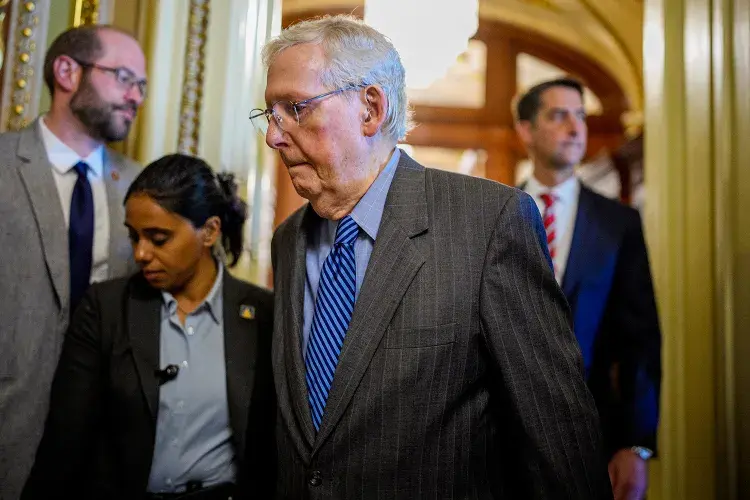
The fall, which was caught on video, happened Tuesday afternoon in a Senate hallway, shortly after a woman from a progressive advocacy group asked McConnell if he supported “ICE taking working people off the streets and kidnapping them.”
Moments later, the senator appeared to lose his balance and collapsed, sending aides and Capitol Police rushing to his side.
A Sudden Fall in the Halls of Power
According to witnesses, McConnell had been walking between committee meetings when the woman called out her question. The longtime senator from Kentucky turned his head briefly toward her, smiled faintly, and appeared ready to continue walking — until his right foot caught on the carpet.
He stumbled, wobbled for a second, then fell to his left side, landing hard but without striking his head. Two aides immediately helped him up while another staffer blocked cameras from getting too close. Within seconds, McConnell stood again, steadied himself on the wall, and muttered, “I’m fine.”
He was escorted to his office, where he remained for several minutes before resuming his schedule. Later that day, he returned to the Senate floor and cast his vote on a budget resolution.
McConnell’s spokesman released a short statement:
“Leader McConnell experienced a brief stumble this afternoon but was not injured. He appreciates the concern and continues to perform his duties.”
Still, the scene has reignited questions about McConnell’s health — and whether America’s aging political class is facing a reckoning.
A Pattern of Health Scares
For the past two years, McConnell’s physical condition has been under close watch. He suffered a serious fall in March 2023, resulting in a concussion and a fractured rib that kept him away from the Senate for nearly six weeks.
That same year, he twice appeared to “freeze” mid-sentence during press conferences — standing silent and unresponsive for roughly 20 seconds before aides stepped in. Those incidents sparked widespread speculation about his neurological health, though doctors later cleared him to continue working, citing no evidence of a stroke or seizure.
In December 2024, McConnell tripped leaving a closed-door lunch with Republican senators, suffering minor bruises. He brushed it off with a familiar line: “It’s not my first tumble, and probably not my last.”
Privately, aides say McConnell has remained sharp in meetings but more cautious in movement. One staffer described him as “mentally strong, physically fragile.”
The Moment That Sparked It
The woman who asked the question has since been identified as a member of the Sunrise Movement, a youth-led organization known for climate and social justice activism. She reportedly asked McConnell about ICE’s treatment of immigrant workers during recent enforcement actions in Texas and Arizona.
Her question was blunt:
“Do you support ICE taking working people off the streets and kidnapping them?”
Video shows McConnell glancing her way with a faint smile before losing his footing. After his fall, she can be heard saying, “Oh my God,” as others rush to help. The video, which spread quickly across social media, has now been viewed millions of times, fueling both sympathy and cynicism online.
Within hours, hashtags like McConnellFall and AgeInPolitics began trending on X (formerly Twitter). While many offered concern for his health, others used the moment to highlight growing frustration with the age and tenure of Washington’s political elite.
The Broader Debate: Age, Health, and Power
McConnell’s latest fall lands at a moment when age and capacity have become dominant topics in American politics. Both parties are grappling with leadership rosters well into their 70s and 80s — President Joe Biden is 82, former President Donald Trump is 79, and several senior senators, including Dianne Feinstein before her death, have faced similar scrutiny.
For decades, McConnell was known for his discipline, strategic patience, and ability to hold his caucus together through turbulent times. But as he moves into his mid-80s, some Republicans privately wonder whether it’s time for him to fully retire.
Last year, McConnell announced that he would step down as Senate Republican leader at the end of 2024, bringing his nearly two-decade leadership run to a close. But he has not announced plans to leave the Senate altogether, where his term runs until 2027.
Political analysts say that may now change.
“Each of these incidents chips away at the perception of strength,” said political historian Laura Chen. “When voters or colleagues see visible frailty, it forces uncomfortable conversations about succession and stability.”
ICE, Immigration, and the Political Undercurrent
Ironically, the question that preceded McConnell’s fall touched on one of the most polarizing issues in U.S. politics: immigration enforcement.
ICE, which has authority to detain and deport undocumented immigrants, has faced fierce criticism in recent months for workplace raids that immigrant-rights groups describe as “intimidating and cruel.” Conservatives, meanwhile, argue that ICE is simply enforcing the law and protecting national security.
McConnell has long aligned with the latter position, supporting strong border measures but avoiding inflammatory language. His pragmatism on immigration has sometimes frustrated both sides — progressives view him as too harsh, while some conservatives see him as too cautious.
The activist’s question, then, wasn’t random. It was a direct challenge to McConnell’s brand of quiet, procedural conservatism — and, in a tragic twist, it coincided with a moment of personal vulnerability.
Reaction Across the Aisle
Lawmakers from both parties expressed concern after hearing the news.
Senator Chuck Schumer, McConnell’s longtime counterpart and sometimes adversary, said, “No matter our differences, I wish Mitch a swift recovery. He’s a tough man, and I know he’ll be back on his feet soon.”
Senator Rand Paul, a fellow Kentucky Republican who has previously questioned the transparency of McConnell’s medical updates, struck a more cautious tone. “I think we need to be honest about what we’re seeing,” Paul told reporters. “These repeated incidents are worrying. Voters deserve full disclosure.”
Even some Democrats, often critical of McConnell’s hardline tactics, urged empathy. “He’s 83 years old and still serving his country,” said Senator Cory Booker. “That deserves respect, not mockery.”
Online, reactions were more divided. Supporters praised McConnell’s resilience, while detractors used the fall to underscore what they see as a larger generational problem in government.
The Human Behind the Power
It’s easy to forget that McConnell’s public image — the calculating strategist, the stoic negotiator — masks a more complicated personal story.
Born in 1942 in Alabama, McConnell contracted polio as a toddler, leaving him unable to walk for months. His mother helped him rebuild strength through therapy and patience. That childhood struggle forged what he often describes as a “quiet determination.”
He rose through Kentucky politics, winning his Senate seat in 1984, and went on to become one of the most influential figures in modern legislative history. From reshaping the federal judiciary to guiding fiscal battles, McConnell has often been called the “architect of Republican power.”
Yet, even his closest allies admit that age has taken its toll.
“He’s still sharp as a tack in strategy sessions,” one GOP aide said. “But the body just doesn’t keep up the way it used to. None of us are immune to that.”
Symbolism and the Public Eye
In the age of viral media, even a simple fall can carry symbolic weight. To some, McConnell’s stumble is an uncomfortable metaphor — a physical manifestation of political decline. To others, it’s just that: an 83-year-old man tripping on a carpet.
The truth, perhaps, lies somewhere in between.
Public life has always demanded both endurance and perception. Every slip, every blank stare, every misstep becomes part of a larger narrative about strength and control. And when those moments happen to someone as powerful and polarizing as Mitch McConnell, they ripple far beyond the walls of the Capitol.
The footage, slowed and analyzed across social media, has been dissected like a political Rorschach test: supporters see grace and resilience; critics see weakness and denial. But stripped of spin, what remains is a reminder that even the most powerful people are still human.
What Happens Next
As of Thursday morning, McConnell’s office reported that he was “resting and in good spirits.” He has not canceled any upcoming Senate business, and aides insist he will continue his work as planned.
Still, this latest incident may accelerate conversations within the Republican caucus about leadership succession and generational renewal. With McConnell stepping down from his leadership role at the end of the term, senators such as John Thune, John Cornyn, and Rick Scott are positioning themselves as possible successors to fill the void.
Meanwhile, calls for broader age and term limits are gaining renewed attention. A recent Pew survey found that nearly 80% of Americans favor setting age caps for federal lawmakers. McConnell’s fall, coming just months before the 2026 campaign cycle begins, could become a flashpoint in that debate.
A Moment That Transcends Politics
For all the speculation, Tuesday’s fall was ultimately a deeply human moment. Cameras may have captured it, but its impact runs deeper than headlines. It was a flash of fragility in a building defined by power — a reminder that no amount of political influence can outrun time.
After being helped to his feet, McConnell reportedly smiled weakly and told an aide, “Don’t make a big deal of it.” But it already was.
In a town obsessed with optics, the image of one of America’s most enduring power brokers losing his balance carried a quiet symbolism — not of failure, but of humanity.
Mitch McConnell has weathered decades of political storms, outlasted rivals, and helped shape the course of the modern Republican Party. Whether admired or despised, his influence is undeniable.
Yet in that brief moment in a Capitol hallway — one question, one stumble, one flash of vulnerability — the conversation shifted from policy to person.
Perhaps that’s the lasting takeaway: behind the titles, behind the partisanship, even the most powerful leaders face the same frailties as the rest of us. The question isn’t just whether McConnell will recover, but what the country learns from watching its leaders, quite literally, fall.