On a crisp Saturday morning, chants of “No kings, no crowns — only democracy now!” echoed across streets from New York to Los Angeles. The message was clear and defiant. Across the United States, hundreds of thousands of Americans poured into parks, city squares, and government plazas under one banner: “No Kings.”
The nationwide demonstrations — organised by a loose coalition of civil-rights groups, student organisations, and local activists — marked one of the largest coordinated protest events since the early days of the Trump presidency.
Their goal, participants said, was not only to criticise policies, but to sound an alarm about what they see as an alarming slide toward authoritarianism.
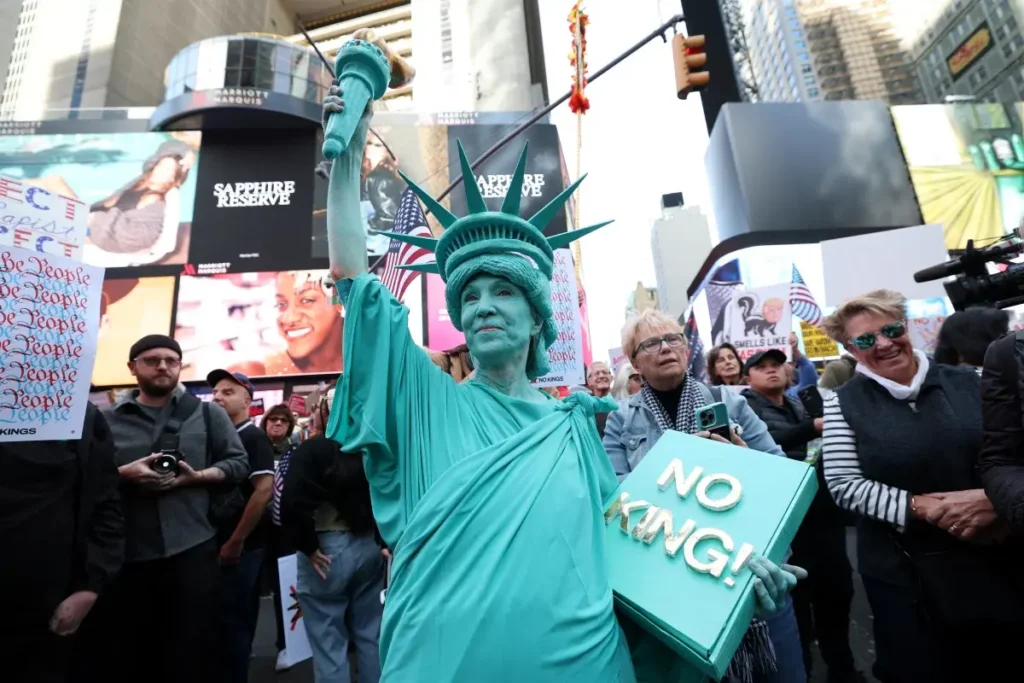
A Movement Born Out of Frustration
The “No Kings” slogan may sound old-fashioned, but the sentiment behind it is deeply modern. It’s a rejection of concentrated political power and an assertion of civic equality.
For many protesters, the phrase carries the echo of America’s founding promise — that this nation would never be ruled by a monarch, or by any one man who sees himself above the law.
In interviews from New York City, Washington D.C., Houston, and Chicago, protesters spoke of frustration, fatigue, and determination. Some were seasoned activists; others were first-timers who said they simply couldn’t stay home any longer.
“I never thought I’d be protesting like this again,” said Linda Chavez, a retired teacher marching in Phoenix. “But when I see the way power is being abused, when laws are being twisted to serve one man’s ego — that’s not the America I taught my students about.”
The phrase “No Kings” first appeared on social media earlier this year, when a group of democracy advocates launched the campaign after a series of executive orders expanded federal control over local policing and immigration enforcement. Within days, it spread like wildfire.
The name caught on precisely because it captured what many Americans were already feeling: that democratic norms were under attack, and that silence was no longer an option.
Protests Stretch Across All 50 States
From Boston Common to Seattle’s Westlake Park, rallies began early and ran into the evening. Organisers estimated that events were held in more than 2,600 locations nationwide, making it one of the largest decentralised protest efforts in recent history.
In Washington D.C., tens of thousands gathered near the National Mall. Handmade signs read “Liberty, not loyalty” and “The Constitution is our king.” The mood was passionate but peaceful; families pushed strollers, volunteers handed out water bottles, and speakers took turns urging calm determination.
In New York, Times Square turned into a sea of blue and white banners. Broadway actors, nurses, and union leaders joined together in song before marching up Seventh Avenue. Police kept a visible but restrained presence, and by mid-afternoon the city’s Office of Emergency Management reported “no significant incidents.”
On the opposite coast, thousands filled Los Angeles’ Grand Park, waving placards that read “Democracy is not a monarchy” and “We the people means all of us.” Traffic slowed for hours, but city officials described the demonstration as “orderly and largely cooperative.”
Even small towns joined in. In The Woodlands, Texas, a suburb north of Houston, about 1,200 residents gathered at a local greenway. They carried lawn chairs, homemade signs, and picnic baskets — more community fair than confrontation. But their words were sharp.
“This isn’t about party politics,” said Jason Reed, a 38-year-old engineer who attended with his wife and two children. “This is about the idea that no one — Republican or Democrat — should be above accountability.”
Peaceful But Tense
While the overwhelming majority of rallies remained peaceful, the political climate surrounding them was anything but calm.
In Texas, Governor Greg Abbott pre-emptively activated the National Guard, citing concerns over “potential unrest.” Armoured vehicles and riot-control police were visible near Austin’s Capitol building hours before the march began.
That show of force frustrated protesters, who said it sent the wrong message.
“They call this a threat to order,” said Tanya Ramirez, a college student at the Austin rally. “But democracy is messy. We’re not breaking windows — we’re exercising rights.”
In Atlanta, police briefly closed parts of Peachtree Street after a scuffle between demonstrators and a small group of counter-protesters waving pro-Trump flags. The altercation lasted only minutes and no serious injuries were reported.
Elsewhere, the day unfolded with an almost festival-like energy. In San Francisco, musicians played folk songs on Market Street. In Portland, children drew chalk crowns on the pavement and then crossed them out — a symbolic act of “removing the king.”
Social media feeds filled with drone shots showing seas of people filling major boulevards, the words #NoKings trending for hours on X (formerly Twitter).
Organisers and Intentions
The protest coalition behind “No Kings” is intentionally leaderless. It includes progressive networks such as Indivisible, MoveOn, and the ACLU, as well as hundreds of smaller community groups.
Their coordination relied heavily on encrypted messaging channels, social media sign-ups, and regional volunteer teams trained in non-violent crowd management.
Organisers insisted that the protests were non-partisan. Their shared statement read:
“We march not against one man, but against the idea that any man is above the law.”
Legal-aid tents were set up in several cities offering “Know Your Rights” pamphlets. Volunteer medics circulated through the crowds, and marshals wearing yellow vests guided foot traffic. By evening, civil-rights lawyers said arrests were minimal — fewer than 150 nationwide, mostly for minor infractions like blocking intersections.
Criticism from the Right
Still, the protests drew harsh criticism from Republican officials.
House Speaker Mike Johnson called them “hate-America rallies” and accused organisers of spreading fear.
“They’re not protecting democracy,” he said in a statement. “They’re undermining confidence in our institutions.”
Conservative media outlets also pushed back, portraying the protests as hypocritical or dangerous. On one talk show, a commentator argued that calling the president a “king” was “irresponsible political theatre.”
Supporters of former President Trump took to social media to counter the trending hashtag with #WeStandWith45, framing the movement as an attack on patriotism.
But protesters said the opposite was true — that defending democracy is the ultimate act of patriotism.
“We’re not against America,” said Nadia Blake, a nurse marching in Chicago. “We’re against the idea that one man can rewrite what America stands for.”
Echoes of the Past
Historians quickly noted the symbolic weight of the “No Kings” message.
More than two centuries ago, the American Revolution began with that same conviction — that liberty cannot coexist with unchecked power.
Political scientist Dr. Erica Feldman from Georgetown University explained:
“What’s remarkable about this moment is how language from the 18th century is resurfacing in 2025. Americans are once again debating the nature of leadership — whether power should flow from the top down, or from the people up.”
Many of Saturday’s protesters carried signs referencing the Founding Fathers. One read: “George Washington walked away from power. Why can’t you?” Another quoted Benjamin Franklin’s famous warning: “A republic, if you can keep it.”
For many, the protests felt not only political, but moral — a defense of civic identity itself.
Different Faces, Shared Fears
The faces in the crowds were as varied as the causes they carried.
In Los Angeles, environmental activists marched beside LGBTQ+ groups and immigrant-rights organisations.
In Detroit, auto-workers joined educators and students.
And in Denver, clergy members held a prayer circle before leading a silent march through downtown.
“This isn’t about one issue,” said Pastor Michael Andrews of Denver’s New Hope Baptist Church. “It’s about the principle that no leader, no government, should forget humility. We’re all servants of something greater — justice, truth, community.”
For many, the protests were also personal.
After the Supreme Court’s recent rulings restricting reproductive rights, some women said they felt their freedoms narrowing. Others worried about press freedom, climate policy, or voting rights.
But when asked why they joined the “No Kings” rallies, their answers converged on one phrase: “Because democracy only works if we defend it.”
Inside the White House Response
The White House issued a brief statement calling the protests “an example of American freedom in action,” while simultaneously accusing “radical elements” of spreading misinformation.
President Trump himself, speaking at a rally in Florida the same afternoon, dismissed the demonstrations as “silly” and “orchestrated by the fake news media.”
“They say ‘No Kings’ — well, we don’t have kings,” Trump told the cheering crowd. “We have elections. And we won big. That’s what they can’t stand.”
His remarks drew laughter from supporters, but also reignited debate over his tone. Political analysts noted that such responses, mocking rather than engaging critics, have become hallmarks of his leadership style.
The Broader Significance
Saturday’s demonstrations may or may not alter policy, but they have undeniably reshaped the political conversation.
For months, critics of the administration warned that the public was becoming numb — that citizens were growing accustomed to controversy. The “No Kings” marches challenged that perception.
Analyst Karen McBride of the Brookings Institution observed:
“Movements like this remind leaders that civic engagement still matters. Whether you agree or disagree with the protesters, the sight of millions of Americans peacefully asserting their constitutional voice is powerful.”
The scale of coordination — across state lines, time zones, and political backgrounds — also reflects how digital activism has evolved. Many participants learned about local events through TikTok and Instagram, where short clips of people drawing “X” marks through cartoon crowns became viral symbols of dissent.
International Solidarity
The message didn’t stop at America’s borders. In London, Madrid, and Berlin, small groups of Americans living abroad held solidarity rallies outside U.S. embassies.
In Toronto, a crowd of about 500 gathered in Nathan Phillips Square, holding candles and singing “This Land Is Your Land.”
“We’re watching from across the border,” said Sarah Goldstein, an American teacher now living in Canada. “But our hearts are still with home. What happens in America affects all of us.”
International media outlets, from The Guardian to Le Monde, gave the protests front-page coverage, noting both the size and the tone — defiant, but peaceful; angry, yet hopeful.
The Road Ahead
By late evening, most marches had dispersed. Streets were swept, police barriers taken down, and city lights flickered back on.
But the echo of the chants lingered: “No Kings! No Kings!”
Whether the movement will continue is uncertain. Organisers have already announced a follow-up campaign — “Democracy Week” — which will focus on voter registration drives and community education.
They hope to channel Saturday’s energy into something more enduring than a one-day protest.
“This can’t just be a moment,” said ACLU spokesperson Janelle Kim. “It has to be a movement — one that lasts beyond the news cycle.”
Political observers agree that sustained civic pressure can influence future elections. But maintaining momentum is difficult. Protests capture attention; policy change requires persistence.
A Turning Point or a Warning Shot?
Every generation of Americans faces its own test of democracy. For some, it comes in war; for others, in the slow erosion of rights.
The “No Kings” protests were not just about one leader, but about a system — a reminder that even in a republic built on freedom, complacency can be dangerous.
By the time night fell, aerial photographs showed glowing lights of cell phones raised in city after city — tiny points of defiance, forming a constellation across the nation.
It was a simple image, but a profound one:
Millions of ordinary people, standing shoulder to shoulder, declaring together that the promise of self-government still matters.
For them, the message wasn’t complicated. It was an echo from America’s very beginning: