In a moment that has sent shock waves through the world of rock and nu-metal, the band Limp Bizkit has announced the death of their founding bassist Sam Rivers at the age of 48. The band’s statement described Rivers as “our brother. Our bandmate. Our heartbeat.”
Though the cause of death has not yet been officially confirmed, the announcement has spurred an outpouring of remembrance and reflection on his life, his music, and his legacy.
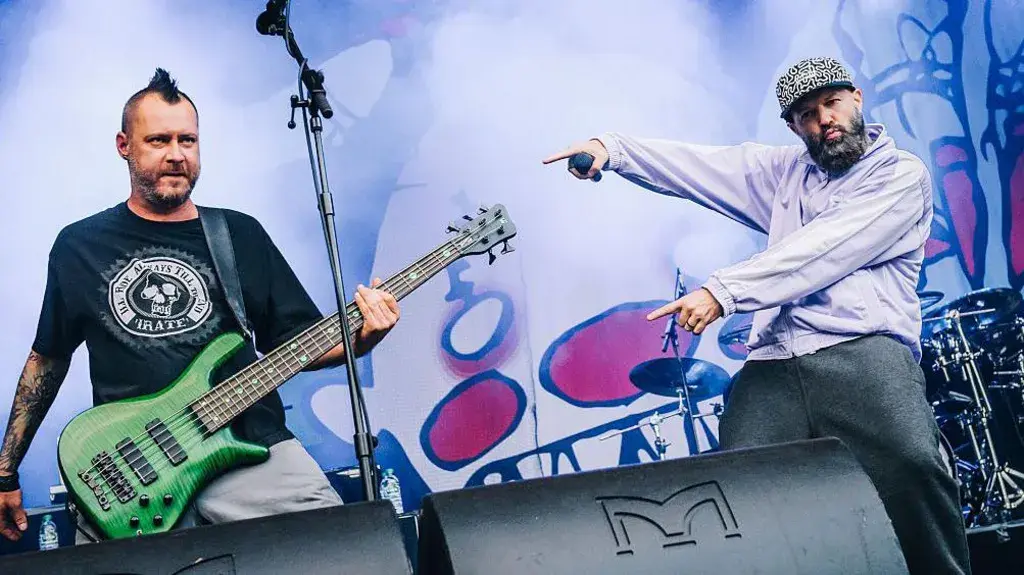
Early Life and Musical Origins
Sam Rivers was born on September 2, 1977, in Jacksonville, Florida, U.S. His musical journey began early: initially he played the tuba in middle school and later transitioned to bass. One key story noted in his biography: Rivers first met drummer John Otto when they were both playing in jazz-band settings in their school, and later he encountered Fred Durst while working a job at Chick-fil-A, which eventually led to the formation of Limp Bizkit. This origin story underlines the humble beginnings of a musician who would become central to one of the defining nu-metal bands of his era.
Formation of Limp Bakit & Rise to Fame
Rivers was one of the founding members of Limp Bakit, formed in 1994 alongside Fred Durst and John Otto. The lineup grew with guitarist Wes Borland and turntablist DJ Lethal, and the band soon developed their distinctive blend of heavy metal, rap-rock, funk, and hip-hop.
Their early albums, such as Three Dollar Bill, Y’all (1997), Significant Other (1999) and Chocolate Starfish and the Hot Dog Flavored Water (2000), propelled them to mainstream success—commercially and culturally.

Through this rise, Rivers held down the bass and backing vocals, providing the groove and backbone to many of the songs that became anthems for a generation.
Rivers’s Style, Contributions & Legacy
What made Sam Rivers stand out? Several aspects:
His bass playing fused groove-oriented heavy rock with funk and rap influences, providing a foundation that was both heavy and rhythmically compelling.
He wasn’t just a bassist: on the band’s 2003 album Results May Vary, with Wes Borland temporarily absent, Rivers also took on guitar parts.
Outside of Limp Bizkit, Rivers produced local bands in Jacksonville and was involved in side-projects (for instance, the band Sleepkillers).
From his early days at 19 when the first album came out to his final years, Rivers’s consistency and presence in the band made him a pillar of the group’s identity.
In the band’s own words:
“Sam Rivers wasn’t just our bass player — he was pure magic. The pulse beneath every song, the calm in the chaos, the soul in the sound.”
This tribute captures how integral Rivers was to the feel and soul of the band.
Personal Struggles & Health Challenges
While Rivers enjoyed success, his path was not without serious personal challenges.
He struggled with alcohol abuse which led to liver disease.
In fact, he took a hiatus from Limp Bizkit in 2015 due to these health problems.Reports indicate that he underwent a liver transplant (circa 2017) and then returned to the band around 2018.
These details add a humanizing dimension to Rivers’s story: behind the stage-presence and grooves was a man fighting serious health demons—yet he pushed through to continue his craft and return to performance.
The Announcement & Immediate Reaction
On October 18, 2025, Limp Bizkit announced on Instagram that Sam Rivers had died at the age of 48. The announcement read in part:
“Today we lost our brother. Our bandmate. Our heartbeat.” Band member DJ Lethal added a comment:
“Give Sam his flowers and play Sam Rivers bass-lines all day! We are in shock. Rest in power my brother! You will live on through your music…” Media outlets reported the death and the tribute widely, mourning the sudden loss and noting that no cause of death had yet been disclosed.
The Impact on Limp Bizkit & the Nu-Metal Scene
The death of Sam Rivers represents not only a personal loss for his family and bandmates, but also a cultural moment for the nu-metal / rap-rock community.
As a founding member, Rivers’s presence spanned the entire major arc of Limp Bizkit’s career: from the late 1990s to the 2020s. His bass work underpinned many of the songs that defined the era—thus his absence leaves a tangible sonic void.
For the band, replacing his voice, his groove, and his personal dynamic is a major challenge; the statement acknowledges that “his spirit will live forever in every groove, every stage, every memory.”
For fans, Rivers’s death may prompt renewed reflection on the band’s catalogue, on the era of nu-metal, and on the role that bassists and rhythm section members play in popular music (often under-recognized compared to frontmen)
Highlights & Milestones in Rivers’s Career
Here are some of the key milestones worth noting:
Rivers played on all six of Limp Bizkit’s studio albums, four of which are certified platinum or multi-platinum.
He was awarded “Best Bass Player” at the Gibson Awards around the year 2000.
His return to the band in 2018 after his health issues showed his resilience and commitment.
He also pursued production work and side projects, enhancing his legacy beyond just the band.
Reflections on Legacy and the Future
Sam Rivers leaves behind a significant legacy. Here are some reflections on that, and on what the future might hold.
Legacy.
Rivers’s bass playing will remain embedded in the sound of Limp Bizkit—his grooves will continue to be heard by current and future generations of listeners.
His story also serves as a cautionary tale about the wear and tear of rock-life: success, heavy touring, substance issues, health consequences—but also recovery, return, and resilience.
His role as a musical anchor reminds us how crucial the rhythm section is: it’s the pulse beneath the songs, as the band said, and that pulse matters.
The Future
For Limp Bizkit, the departure of such a foundational figure raises questions: How will the band proceed? Will there be tribute shows? A replacement? A shift in direction?
For fans, this is a moment to revisit the band’s catalogue, to appreciate the musicianship that under-pinned the hits, and perhaps to re-examine the broader cultural impact of nu-metal.
In memory of Rivers, bass-players and aspiring musicians might examine his style, his tone, his groove—and derive inspiration from his musical approach.
On October 18, 2025, we lost Sam Rivers—a musician, a bandmate, a friend to many, and a heartbeat of one of rock’s iconic acts. While the cause of death remains unconfirmed at this writing, what remains unmistakable is the imprint he left: on music, on bandmates, on the fans who moved to the grooves he delivered.
In the words of Limp Bizkit:
“We’ll carry you with us, always. Rest easy, brother. Your music never ends.”
His life reminds us that behind the roar of a stadium crowd, behind the distortion of a metal riff, there is a human being whose presence—steady, creative, vital—shaped the moments that made us feel, move, connect. Sam Rivers gave us those moments. And for that, we are grateful.