
When the Golden State Warriors traded for Jimmy Butler, the reaction across the league was a mix of surprise and curiosity. Why would a team already known for its fiery leadership and unpredictable energy add a player like Butler — famous for his intensity, no-nonsense attitude, and relentless competitiveness?
Now, months into his stint in the Bay Area, the answer is obvious: Butler brought balance to the storm.
He didn’t come to reinvent the Warriors. He came to steady them. In a locker room where Steph Curry’s brilliance and Draymond Green’s volatility often define the tone, Butler has emerged as the quiet center — the veteran voice that turns chaos into control.
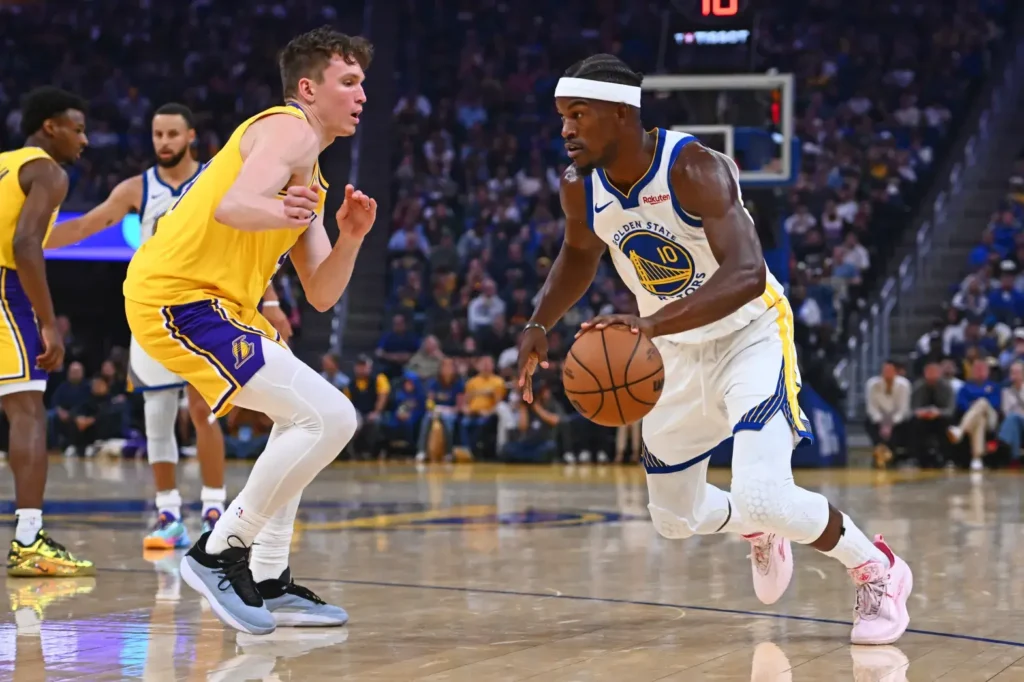
A Franchise That Needed a Compass
For years, the Warriors thrived on beautiful chaos — the free-flowing offense, the hot-hand threes, the unpredictable defensive rotations that somehow always clicked. But as the dynasty aged and the roster around Curry and Green changed, that chaos sometimes turned self-destructive.
The 2024–25 season began with flashes of brilliance and long stretches of frustration. One night, Curry would drop 45 in a win; the next, the Warriors would blow a 17-point lead with careless turnovers and defensive lapses.
It wasn’t about talent — it was about rhythm. And rhythm is exactly what Butler brought.
From his first practice, he established a tone. “We’re not out here to play cute basketball,” he told teammates. “We’re here to win.” That message, according to multiple players, hit home immediately.
Head coach Steve Kerr put it perfectly after a late-season win over Phoenix:
“Steph and Draymond bring the chaos — the fire, the speed, the emotion. Jimmy brings the calm. He’s the balance we’ve needed.”
Understanding the Chaos
When Kerr talks about chaos, he doesn’t mean dysfunction. He means energy — the kind that fuels a dynasty but can also burn out a team when it’s not managed.
Curry’s game is built on movement and improvisation; he’s basketball jazz. Draymond, meanwhile, plays defense like a conductor in a storm — loud, emotional, and sometimes volatile.
Those qualities made them legends, but without a third voice to anchor them, the Warriors’ pendulum swung wildly from transcendent to unhinged.
That’s where Butler comes in.
He doesn’t demand the spotlight. He doesn’t speed things up. He just organizes. Whether it’s calling for a reset when the offense gets too frantic or quietly pulling Draymond aside after a heated exchange, Butler reads the room better than anyone.
“You can feel the temperature drop when he speaks,” said one Warriors staffer. “He’ll just say, ‘We’re fine. Next play.’ And suddenly everyone’s breathing again.”
The Art of Control
1. Slowing the Game
In a league obsessed with pace, Butler’s greatest skill might be his ability to hit the brakes. When the Warriors get caught in their own speed — forcing threes, skipping defensive rotations — Butler finds a way to slow the tempo and reset the rhythm.
He doesn’t force highlight plays. He draws contact, gets to the line, and turns the game into a grind. That steadiness has been contagious.
Since joining the Warriors, Golden State’s turnover rate has dropped, their late-game efficiency has climbed, and their half-court sets look sharper. As Kerr said:
“Jimmy never rushes. He plays the same whether we’re up 10 or down 10. That’s leadership.”
2. Defensive Backbone
While most attention lands on his poise and IQ, Butler’s defensive influence might be even bigger. He guards wings, helps on bigs, and communicates like a coach on the floor. His presence has taken pressure off Draymond, who no longer has to quarterback every possession alone.
With Butler and Green sharing the court, the Warriors’ defensive rating has ranked among the league’s top five. He may not chase blocks or steals like younger players, but his timing and positioning are textbook.
“He’s like a safety net,” said Draymond. “If I gamble, I know he’s there. He reads the floor like he’s seen the movie already.”
3. Veteran Leadership Without the Drama
Perhaps the most surprising part of Butler’s run with the Warriors is how easily he’s meshed with a team that already has loud voices.
His leadership isn’t about shouting or making speeches. It’s about consistency. He shows up early, takes responsibility, and never asks for credit. For a locker room that sometimes fed on emotion, Butler’s steadiness has been grounding.
One team source put it this way:
“Jimmy’s not trying to be the loudest. He’s trying to be the most dependable.”
Even Curry — who has led by example his entire career — admitted Butler’s approach has rubbed off.
“Jimmy doesn’t let us get too high or too low,” Curry said. “That’s the kind of stability every great team needs.”
The Numbers Don’t Lie
Butler’s impact shows up beyond the eye test. Since his arrival:
The Warriors have ranked second in both offensive and defensive efficiency over a 10-game stretch.
Their turnover percentage dropped by nearly 15%.
Free-throw attempts climbed to their highest mark since 2019.
And the clutch win rate — games decided by five points or fewer — improved dramatically.
These aren’t flashy stats, but they’re the ones that decide playoff series.
It’s not hard to see the connection: when the Warriors are under control, they’re almost unbeatable. When they aren’t, they look mortal.
The Relationship With Curry and Green
The chemistry between the three veterans has been the story of the season.
Curry and Butler have developed mutual respect — one a virtuoso scorer, the other a master of tempo. They don’t compete for touches; they complement each other. Curry’s movement creates space, and Butler’s patience fills it.
Draymond, on the other hand, needed time. Known for his fiery personality, he wasn’t sure how another vocal leader would fit. But it didn’t take long.
“Jimmy’s blunt,” Draymond said. “He’ll call you out, but he’ll dap you up the next play. That’s real. You can work with that.”
Now, the two are often seen huddled together during timeouts, dissecting defensive rotations like chess players. Butler’s arrival hasn’t muted Draymond — it’s just given his energy direction.
The Culture Shift
What’s happening in Golden State isn’t just tactical — it’s cultural.
In past seasons, the Warriors could feel manic: breathtaking one night, disjointed the next. Butler’s presence has flattened those emotional peaks and valleys.
Players say practices are more focused. Film sessions more detailed. The message clearer. “We used to talk about playing beautiful basketball,” said Kevon Looney. “Now we talk about playing smart basketball.”
It’s a subtle difference, but a meaningful one.
Butler’s work ethic also resonates. He’s the first one in the gym, often sweating through solo drills before shootaround. That professionalism has influenced the younger players, especially guys like Brandin Podiums and Jonathan Kamanga, who’ve grown under his example.
Kerr summed it up simply:
“He’s made everyone around him sharper.”
The Off-Court Anchor
Off the floor, Butler has leaned into the community and culture of the Bay Area. He’s taken teammates out for dinners, hosted film nights, and encouraged open communication.
One team staffer described him as “the adult in the room” — not because the Warriors lacked maturity, but because they finally had someone who treats every game like a business trip.
Even when Curry was sidelined briefly with a sprained ankle, Butler became the emotional leader. He called a players-only meeting, not to lecture, but to refocus. The Warriors responded with a three-game win streak that kept them afloat in the standings.
Balancing Passion and Poise
There’s a paradox to Butler’s style. He plays with fire but leads with calm. He’s emotional without being erratic.
That’s exactly what the Warriors needed.
When Draymond gets fired up, Butler’s the one patting him on the back and redirecting the energy. When Curry goes cold, Butler quietly takes over for a few possessions until Steph finds rhythm again.
He doesn’t try to outshine anyone. He just fills the gaps — the kind of leadership that doesn’t show up in highlights but wins championships.
Looking Ahead
As the Warriors push through the season, the question isn’t whether Butler fits — it’s how far he can take them.
At 36, he’s not the same explosive scorer he once was, but he’s arguably smarter, more selective, and more self-aware. He’s playing within his limits and maximizing everyone else’s.
The Warriors aren’t just better with Butler — they’re different. They no longer rely solely on Curry’s hot streaks or Draymond’s emotion. They have a third identity: discipline.
And for a team chasing one last championship run with its core intact, that might be the difference between nostalgia and another banner.
Why It Works
What makes Butler such a perfect fit in Golden State is that he values the same things the Warriors built their dynasty on — accountability, intelligence, and unselfishness. But he also brings what they lacked in recent years: edge and emotional control.
He’s not afraid to challenge stars. He’s not intimidated by expectations. And he’s not satisfied with just being competitive.
As one assistant coach put it, “He’s the first guy since KD who’s walked in here and made everyone sharper, not just better.”
Jimmy Butler didn’t come to the Warriors to change them. He came to remind them who they were — a team that thrives on connection, trust, and controlled chaos.
Curry’s genius still dazzles. Draymond’s fire still fuels. But Butler’s calm — that rare, grounded leadership — has turned their storm into strategy.
He’s the thermostat in a room full of sparks, the steadying voice that turns chaos into championship focus.
And if this version of the Warriors ends up holding another trophy, history might remember it as the season Jimmy Butler didn’t just join them — he saved their balance.



Pingback: Cloudflare Resolves Major Outage Hitting X and ChatGPT
Pingback: Cloudflare Resolves Outage That Disrupted Parts of the Internet
Pingback: Bucs' Baker Mayfield exits loss to Rams with left shoulder sprain