
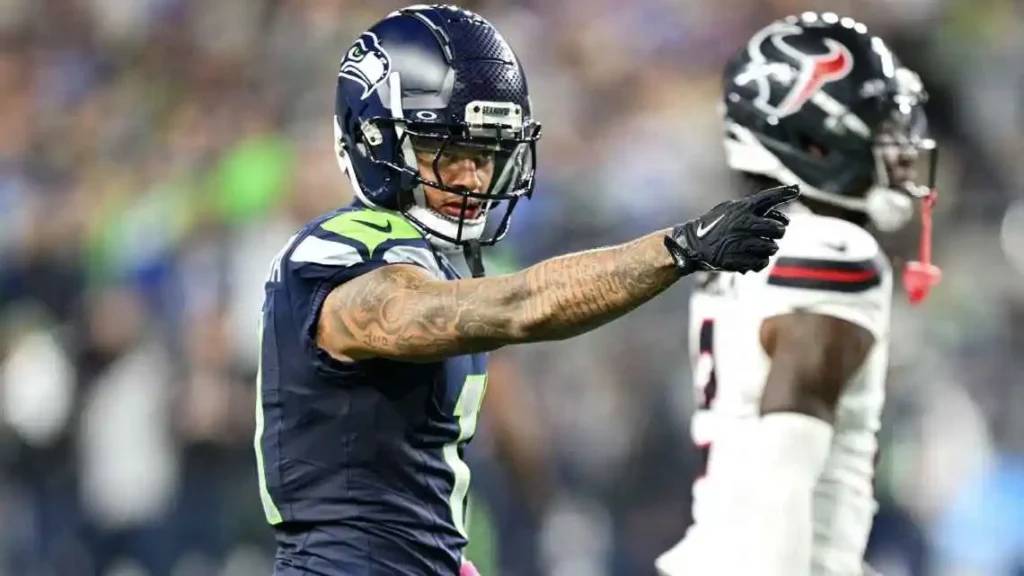
The Seattle Seahawks didn’t just beat the Houston Texans on Monday night — they sent a message to the rest of the NFL. With a defense that looked every bit like a playoff-caliber unit, Seattle smothered Houston’s high-powered offense in a 27–19 victory at Lumen Field.
The win pushed the Seahawks to 5–2 on the season and reminded everyone that even in an era dominated by offensive fireworks, defense still wins games.
Setting the Tone Early
Seattle came out of the gates playing with an edge. From the very first possession, the Seahawks’ front seven made life miserable for Houston quarterback C.J. Stroud. Every time he dropped back, it seemed someone in blue and green was collapsing the pocket.
The Seahawks’ offense struck first when Sam Darnold found Jaxon Smith-Njigba on a crisp out route for a touchdown, capping a 75-yard opening drive that set the tone. Smith-Njigba was the spark all night, finishing with eight catches for 123 yards and the score.
While Seattle’s offense stumbled later with turnovers, the defense more than compensated. Houston managed just 254 yards of total offense — one of their lowest outputs of the season — and never found a rhythm.
The Defensive Clinic
This game was all about the Seahawks’ defense. Coordinator Clint Hurtt’s group was disciplined, fast, and downright nasty up front.
1. Pressuring Stroud All Night
C.J. Stroud entered the game as one of the league’s steadiest young quarterbacks, but Seattle’s defensive front had other plans. The Seahawks sacked him three times and hit him countless others, forcing hurried throws and breaking Houston’s timing routes.

According to postgame stats, Seattle pressured Stroud on nearly one-third of his dropbacks. Under pressure, Stroud completed just four of fourteen passes for 55 yards and an interception — a clear sign of how disruptive Seattle’s pass rush truly was.
Veteran defensive end Dre’Mont Jones and edge rusher Boye Mafe were relentless, combining for key third-down stops that ended promising Houston drives before they began. Rookie Byron Murphy II also made his presence known, clogging interior lanes and drawing double teams that freed up linebackers to attack.
2. Dominating the Run Game
Houston’s ground attack was virtually nonexistent. The Texans managed just 31 rushing yards on 15 carries, and their longest run of the night went for a mere seven yards.
Seattle’s linebackers — led by Bobby Wagner and Uchenna Nwosu — filled gaps perfectly and tackled with precision. Wagner, now in his twelfth season, looked as sharp as ever, diagnosing plays before the snap and blowing up runs in the backfield.
Every attempt Houston made to establish balance was shut down immediately. By the second half, they had no choice but to become one-dimensional — and that’s exactly what Seattle wanted.
3. Winning on Third Down
The Texans converted just four of thirteen third-down attempts, a testament to Seattle’s situational awareness. On nearly every critical down, the Seahawks tightened coverage and sent disguised blitzes that forced quick throws and incompletions.
Cornerback Devon Witherspoon, who continues to play beyond his years, blanketed Houston receivers all night. His physical coverage and closing speed kept star receiver Nico Collins from making a single impact play until the fourth quarter, when the game was already leaning heavily in Seattle’s favor.
4. Bend, Don’t Break
Even when Seattle’s offense turned the ball over — four times in total — the defense refused to crumble. Three of those giveaways came deep in Seahawks territory, yet Houston managed only six points off those turnovers.
That kind of resilience is the mark of a championship-caliber defense. Whenever the Texans started to gain momentum, Seattle’s defenders stepped up, made a key tackle, or batted down a crucial third-down pass.
The Offense: Flashes and Frustrations
While the defense carried the night, Seattle’s offense was inconsistent. Sam Darnold, who has been serviceable as Geno Smith recovers from injury, had an up-and-down performance — 17 completions on 31 attempts for 213 yards, one touchdown, and one interception.
There were moments when Darnold looked poised, especially early when he spread the ball around to Smith-Njigba, DK Metcalf, and tight end Noah Fant. But turnovers and miscommunication plagued the offense throughout the middle quarters.
The bright spots came in the running game. Rookie back Zach Charbonnet scored two short-yardage touchdowns, showing the power and patience that made him a second-round pick. Kenneth Walker III added 66 yards on 17 carries, consistently grinding out tough yards between the tackles.
Still, four turnovers nearly cost Seattle the game. Two came on fumbles after long completions, and another was an ill-advised throw from Darnold across his body that ended in an interception.
Head coach Mike Macdonald didn’t sugarcoat it afterward:
“We can’t put our defense in those positions week after week,” he said. “They bailed us out tonight, no question. But we’ve got to be cleaner offensively.”
He’s right. The Seahawks can’t afford to keep giving away possessions, not in a division that includes the 49ers and Rams.
Houston’s Struggles Continue
For the Texans, this loss was a frustrating reminder of how far their offense still has to go.
C.J. Stroud finished with 229 yards on 23-of-49 passing — a stat line that looks more like a pitcher’s box score than a quarterback’s. He did throw one late touchdown to Tank Dell, but by then, Seattle’s defense was in control.
The Texans’ inability to run the ball made them predictable. Without balance, Stroud faced constant pressure, and his usually efficient decision-making faltered.
Houston’s lone real chance to swing momentum came late in the third quarter, trailing 20–13. Facing a fourth-and-one at their own 41, the Texans opted to go for it. Running back Dameon Pierce was stuffed short of the line, and six plays later, Charbonnet scored his second touchdown to push Seattle’s lead to two scores.
That failed conversion summed up Houston’s night — bold intent, poor execution.
Head coach DeMeco Ryans was blunt afterward:
“They played harder, they played faster, and they deserved to win. We didn’t match their physicality.”
For a Texans team that has prided itself on toughness and discipline, that’s a wake-up call.
Key Turning Points
Every great defensive performance has its defining moments, and Monday night had plenty.
Early Sack on 3rd-and-7 (First Quarter): Boye Mafe blew past the right tackle for a drive-killing sack that set the tone early.
Goal-Line Stand (Second Quarter): Houston had first-and-goal from the Seattle 5-yard line after a Darnold interception. Three plays later, they settled for a field goal after Wagner and Jarran Reed stuffed consecutive runs.
Fourth-and-One Stop (Third Quarter): As mentioned, the Texans’ failed conversion deep in their own territory swung the game’s momentum permanently toward Seattle.
Late Interception (Fourth Quarter): With Houston trying to mount a comeback, rookie safety Jerrick Reed II picked off Stroud to seal the win.
Each of those plays highlighted a defense playing with awareness, speed, and unity — qualities Seattle fans haven’t consistently seen since the Legion of Boom era.
The Return of Seattle’s Defensive Identity
For years, the Seahawks were known for their physical, fast, and fearsome defense. Monday night’s win felt like a throwback to that identity.
Bobby Wagner continues to lead with quiet dominance. Witherspoon has the swagger of a young Richard Sherman. And the defensive line rotation, deep and versatile, gives Seattle flexibility they lacked last season.
They’re not quite the Legion of Boom — but they’re building something special again.
Safety Julian Love said it best after the game:
“We take pride in being the reason we win. Offense will get there, but defense travels. That’s what we hang our hats on.”
When a defense believes that deeply in itself, opponents take notice.
What This Win Means for Seattle
At 5–2, the Seahawks are right in the thick of the NFC West race. The 49ers may still be the class of the division, but Seattle’s defensive consistency gives them a legitimate shot to challenge for the crown.
This win also comes at the perfect time — just before their bye week. The break will allow the offense to regroup and for injured players like Geno Smith and Charles Cross to get healthier.
Most importantly, it cements the identity that head coach Mike Macdonald has been trying to instill since taking over: discipline, toughness, and defense first.
The Seahawks are far from perfect, but this game showed their formula for winning tough matchups:
Win at the line of scrimmage.
Limit explosive plays.
Let the defense set the tone.
It’s simple football — but on Monday night, it worked to perfection.
What This Loss Means for Houston
For Houston, the loss drops them to 2–4 and adds more urgency to fix their offensive line issues. The Texans have the talent to compete, but inconsistency on offense — especially up front — continues to derail them.
The good news? Their defense remains a top-10 unit, and they played well enough to keep them in the game despite poor field position all night. Will Anderson Jr. and Derek Stingley Jr. were standouts, combining for several pressures and a forced fumble.
The bad news? The offense can’t protect its quarterback or stay on schedule. Without a reliable run game or short passing rhythm, Stroud was left to fend for himself against constant blitzes.
If Houston wants to stay competitive in the AFC playoff picture, they’ll need to fix protection schemes and find more consistency on early downs.
The Bigger Picture
Every NFL season has games that define a team’s character. For Seattle, this was one of those nights. They weren’t flawless. They turned the ball over. They made mistakes. But they played with resilience, and their defense responded to every challenge.
It wasn’t a win built on flash or finesse — it was built on grit.
This is exactly the kind of football that travels in December and January.
The scoreboard read 27–19, but the game felt more lopsided than that. The Texans had a few late drives to make the score respectable, yet Seattle’s defense controlled the action from the opening kick.
It was a statement win — not just another “W” in the standings.
For the first time in years, the Seahawks look like a team that can dominate physically. Their offense has room to grow, but if the defense continues to play like this, Seattle could become one of the NFC’s most dangerous teams down the stretch.
As fans filed out of Lumen Field into the cool October night, the feeling was unmistakable: the Seahawks’ defense is back — and it might just carry themselve.