
one filled with pride, promise, and a fair share of heartbreak. In Goa, local football club FC Goa stood toe-to-toe with the mighty Al Nasr in the AFC Champions League 2, giving the Saudi giants a genuine scare before falling short in a spirited 2-1 loss.
Meanwhile, across the globe in France, young Indian shuttler Unnati Hooda contactor 22, 2025, turned out to be an eventful day for Indian sports fans — inured her impressive rise, producing a remarkable comeback win to advance to the second round of the French Open Badminton Super 750.
Both performances — though contrasting in outcome — carried a shared thread: resilience, growth, and the unmistakable hunger of Indian athletes to make their mark on the world stage.
Part 1: Al Nassr Survive Goa’s Brave Challenge
The Build-Up: David vs. Goliath
When the fixtures were drawn for the AFC Champions League 2, few imagined FC Goa would give Al Nassr any real trouble. After all, the Saudi side came in stacked with international stars, high expectations, and the financial might of one of Asia’s top clubs. Goa, by contrast, are still building their identity as Indian football’s continental ambassadors.
Yet, under the floodlights of Fatorda Stadium, the Indian outfit didn’t just show up — they competed.
A packed crowd roared every time the home side won a tackle, pressed high, or broke forward. For fans who have followed Indian club football for years, this wasn’t just a game; it was a glimpse of what’s possible when self-belief meets preparation.
The Match: Early Shock, Late Fight
The first whistle set the tone: Al Nassr looked comfortable in possession, and Goa were content to hold shape and hit on the counter. But within minutes, the quality gap showed.
In the 10th minute, Al Nassr’s Angelo Gabriel opened the scoring with a curling shot from outside the box — a strike that silenced the stadium momentarily. Goa’s goalkeeper could only stretch helplessly as the ball nestled in the top corner.
Before the home fans could recover, things went from bad to worse. In the 27th minute, Haroune Camara doubled Al Nassr’s lead, finishing from close range after a neat passing move carved open Goa’s defense.
At 2-0 down, most teams would have folded. But Goa didn’t.
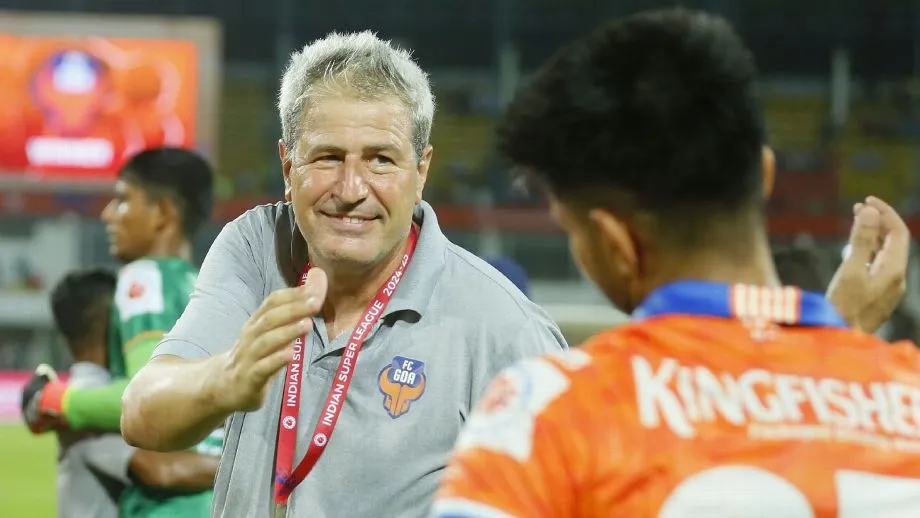
Coach Manolo Marquez made an early tactical switch, bringing on Brison Fernandes for the injured Javier Siverio — a move that changed the energy of the game. Fernandes, a product of Goa’s youth system, brought urgency and fearless intent.
And it paid off.
In the 44th minute, Fernandes pounced on a clever through ball from Borja Herrera, cut inside, and rifled a low right-footed shot into the corner. The stadium erupted.
Goa went into halftime trailing 1-2, but with momentum — and belief — on their side.
The Second Half: Holding Firm
The second half began much like the first: Al Nasr dominating possession, but Goa refusing to roll over.
Every block, every interception, and every counterattack drew applause from the stands. The Indian side’s defensive structure tightened, and goalkeeper Arshdeep Singh made a couple of crucial saves to keep them in the contest.
In the final 15 minutes, Goa pushed higher up the pitch, chasing an equalizer. Substitute Abdul Rabeeh came close after a dazzling run down the right, but his final pass narrowly missed connecting with Noah Sadaoui inside the box.
Al Nassr, seasoned in closing out tight games, slowed down play and held onto the ball in the dying moments. When the referee blew the final whistle, the scoreline read Al Nassr 2 – FC Goa 1, but the performance felt like a moral victory for the hosts.
Post-Match Reactions
Goa’s coach Manolo Marquez praised his players’ commitment:
“We played against one of Asia’s best clubs. We made mistakes, yes, but we also showed courage and personality. That’s how you learn and grow.”
For Al Nassr manager Luis Castro, it was a case of relief and respect:
“Goa surprised us. They are organized, brave, and difficult to break down. We’re happy to take the points.”
The match might have ended in defeat, but the takeaway for Indian fans was clear — the gap between domestic football and continental competition is narrowing, one game at a time.
Tactical Takeaways
Goa’s Discipline: Despite facing waves of pressure, Goa’s compact shape and midfield work rate kept them competitive.
Brison Fernandes’ Impact: The young midfielder’s energy and goal were proof that Indian clubs’ investment in youth is starting to pay off.
Al Nassr’s Professionalism: Their ability to manage the tempo in the final stages showed why they remain among Asia’s elite.
Broader Significance
For FC Goa and Indian football, the result was bigger than the scoreboard. Scoring against a powerhouse like Al Nassr — and pushing them to the limit — sends a powerful message about how far Indian club football has come.
The Indian Super League’s increased competitiveness, better facilities, and international exposure have begun to show real dividends.
As one fan summed it up on social media:
“We didn’t win, but we made Al Nassr sweat. That’s progress.”
Part 2: Unnati Hooda Advances at the French Open
While football fans in Goa were catching their breath, thousands of miles away in Rennes, France, a young Indian shuttler was quietly making history of her own.
A Star in the Making
Unnati Hooda, just 18 years old, is quickly becoming one of India’s brightest badminton prospects. Already the youngest Indian to win a BWF international title, Hooda continues to climb the ranks with every tournament.
At the French Open Super 750, she faced Malaysia’s Letshanaa Karupathevan — an experienced opponent known for her aggressive play and tactical intelligence.
The match didn’t start well for Hooda. She looked tentative, losing the first game 11-21 as Karupathevan dominated with sharp net play and precise smashes. But instead of panicking, Hooda regrouped.
What followed was a stunning turnaround.
She began the second game aggressively, pushing her opponent deep with powerful clears and dictating rallies. Her confidence grew with every point, and she took the second game 21-13.
By the decider, the Indian teenager was in complete control. Playing with maturity beyond her years, she forced errors, maintained tempo, and closed the match 11-21, 21-13, 21-16.
Reaction and Recognition
After the win, Hooda remained grounded, saying,
“The first game got away from me, but I trusted my training and told myself to keep fighting. Every match at this level is a lesson.”
Her calm, composed attitude has already caught the attention of senior players and coaches in India. With stars like PV Sindhu and Saina Nehwal paving the path before her, Hooda represents the next wave of Indian women’s badminton — confident, disciplined, and fearless.
The Road Ahead
Advancing to the second round of a Super 750 event is a major achievement, especially for someone so young. But the journey is far from over.
Her next match will likely pit her against a top-10 ranked player — a test of both endurance and mindset. Regardless of the outcome, this tournament has already proven that Unnati Hooda is no longer just a promising junior — she’s a legitimate contender.
Part 3: What These Stories Mean for Indian Sports
On paper, Al Nassr’s win and Hooda’s advancement might seem unrelated. But together, they paint a powerful picture of where Indian sport stands today.
Both performances share a theme — resilience in the face of elite competition.
In Goa’s case, it was a collective display of courage. Against world-class opposition, they didn’t just defend; they fought back. For Hooda, it was personal resilience — the refusal to crumble after a poor start, the courage to reset and turn things around.
These moments matter because they signal a larger shift in mindset. Indian athletes and teams are no longer satisfied with participation; they’re chasing results. They’re learning to adapt, to handle pressure, and to believe that they belong on the same stage as the best.
A Growing Sporting Culture
The stories of FC Goa and Unnati Hooda highlight how far India’s sporting landscape has evolved in just a decade.
Infrastructure: Better coaching, analytics, and exposure are helping athletes prepare at world-class levels.
Confidence: Competing against global opposition is now a routine expectation, not an exception.
Diversity: From football to badminton, from individual to team sports, Indian representation is expanding rapidly.
For fans, that means more moments of pride — and heartbreak — as India integrates deeper into the global sporting fabric.
Part 4: The Road Ahead
For FC Goa
Their journey in the AFC Champions League 2 continues. The next few matches will test their endurance, consistency, and ability to learn quickly. But the signs are positive. Goa have shown they can play brave, structured football — a foundation to build on.
If they can tighten defensive lapses and sharpen finishing, there’s no reason they can’t compete toe-to-toe with Asia’s best on a regular basis.
For Unnati Hooda
The challenge is consistency. At 18, the temptation to rush progress is high, but Hooda’s calm demeanor suggests she understands the process. She’s backed by the Badminton Association of India and the national training setup — a support system that has produced Olympic medallists before her.
Each tournament she plays adds layers to her experience, maturity, and tactical knowledge.
Part 5: The Bigger Picture
October 22, 2025, may not go down as a day of record-breaking victories for India, but it stands as a symbol of progress — the kind that doesn’t always make headlines but builds the foundation for future success.
From Goa’s resilience under the Fatorda lights to Unnati Hooda’s fightback in faraway France, the message is the same: India is learning to compete, not just participate.
In sport, as in life, that’s how transformation begins — one brave performance at a time.
Football’s beauty lies in moments of courage; badminton’s in precision and patience. On this single day, Indian athletes showed both.
FC Goa may have lost 2-1, but they won respect — proving that Indian clubs can challenge Asia’s best. Unnati Hooda may just be starting her journey, but her victory in France hints at a bright future for Indian badminton.
For fans, it was a reminder that sport is not just about results, but about belief. And right now, belief in Indian sport has never been stronger.


Pingback: Cloudflare Outage Disrupts Web, Recovery Underway Slowly Now
Pingback: Cloudflare Resolves Major Outage Hitting X and ChatGPT
Pingback: Hunt for ex-Olympian ‘kingpin’ intensifies amid SCOTUS clash